
Bowed basement walls: causes, warning signs, and what to do before it gets worse
If your basement wall is leaning inward or showing a horizontal crack across the middle, this page gives you a straight answer on what is happening, how serious it is, and what your options are. Stealth Foundation has assessed bowed basement walls throughout Greater Cincinnati and Northern Kentucky since 2010. Free inspections. No obligation.
Call (513) 489-0332 in Ohio or (859) 356-1002 in Northern Kentucky, or schedule online:
Schedule your free owner inspection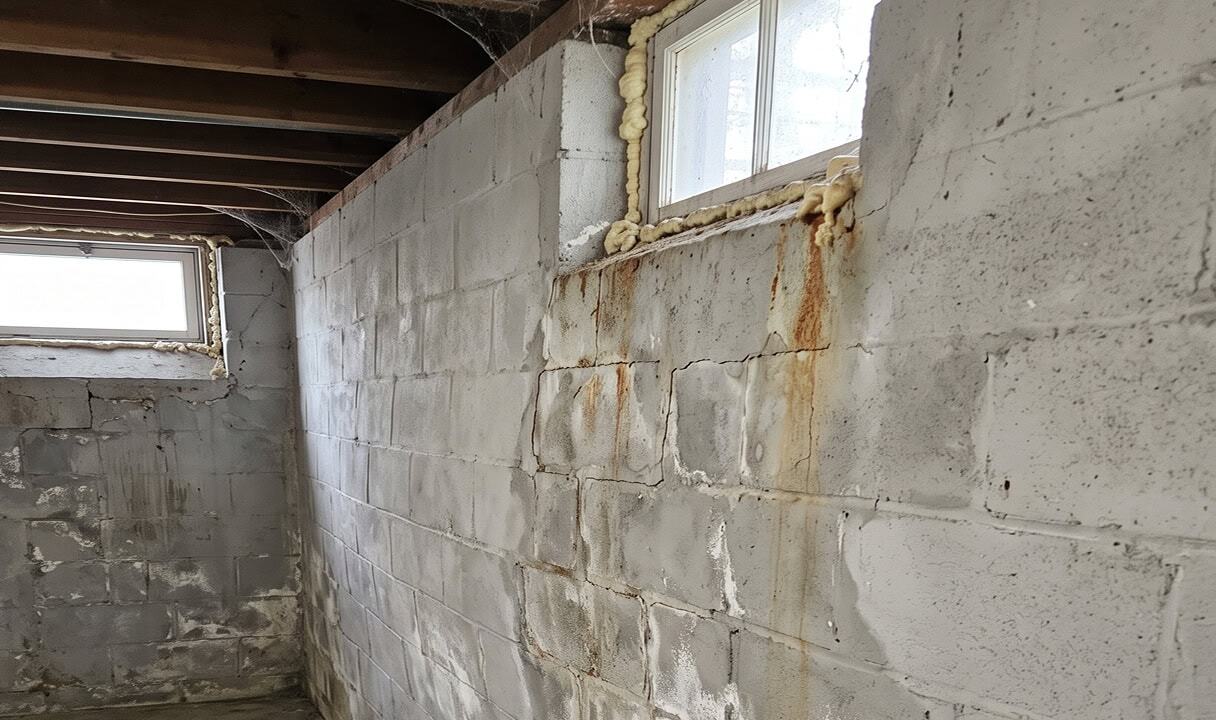
- Free owner inspection, no obligation
- 61 years combined experience in local clay soil
- Repairable in most cases when caught early
Understanding the problem
What is a bowed basement wall?
A bowed basement wall is a foundation wall that has been pushed inward by the lateral pressure of the surrounding soil.
The wall does not fail suddenly. It moves gradually over months or years as accumulated pressure from water-saturated clay, freeze and thaw cycles, and the weight of the soil exceeds what the wall was built to resist. The movement is structural, not cosmetic, and it does not stop on its own.
In Greater Cincinnati and Northern Kentucky, bowed walls are among the most common foundation problems we see, and it is rarely a sign the wall was built poorly. Older block-foundation homes across the region were sound for their era, but they have been carrying sustained lateral pressure for far longer than the walls were designed to manage alone. In most cases, what you are seeing is a normal wall under an abnormal, long-running load.
A bowed wall is repairable in most cases, and the options are broadest when it is caught early. A free professional inspection is the right first step.
Why bowed walls are common in the Greater Cincinnati and Northern Kentucky area
-
Expansive clay soil
It swells with moisture and presses inward against the wall, every wet season.
-
Ohio River valley moisture
The ground stays saturated longer than it would in drier, sandier regions.
-
Mid-century block foundations
Walls built from the 1940s to 1970s have absorbed decades of pressure.
Do you have a bowing wall?
Warning signs of bowed basement walls
Most homeowners notice one sign, assume it is cosmetic, and move on. Some of these signs are cosmetic. Some are not. Knowing the difference matters.
-
Walls leaning or curving inward
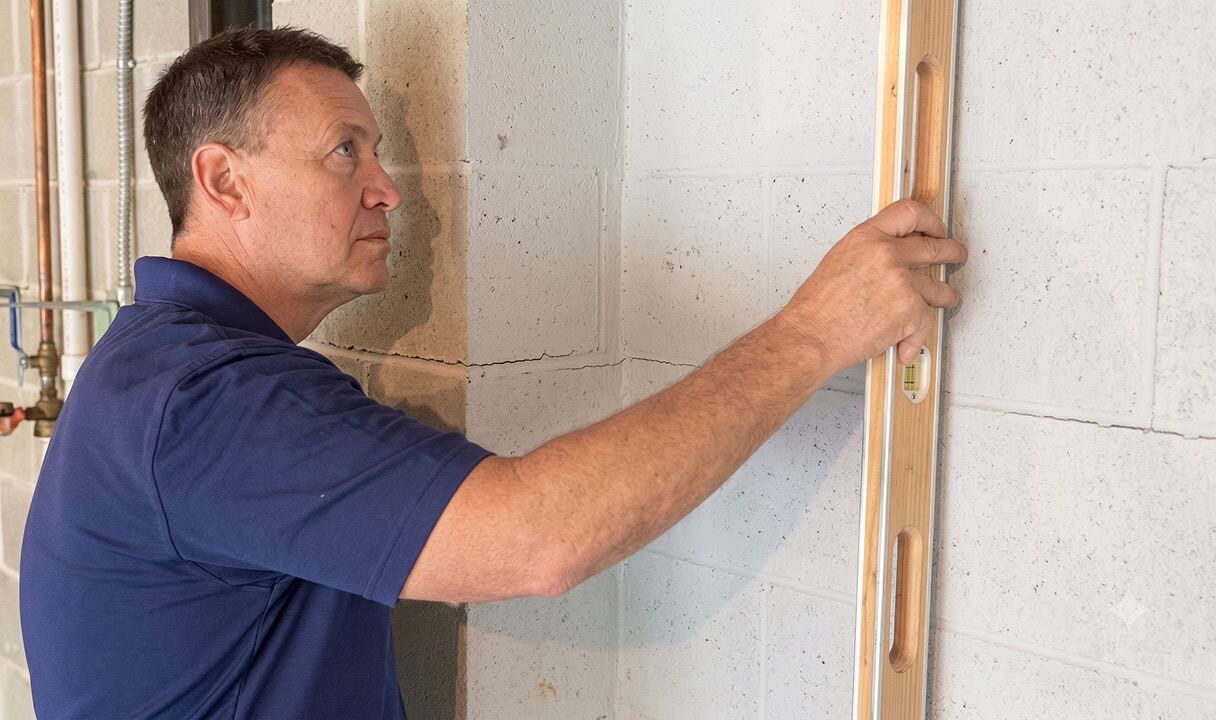
A wall that has moved enough to be visually off-plumb has moved significantly. Run a long straightedge from the top of the wall to the floor, and any gap in the middle confirms inward displacement.
-
A horizontal crack across the middle
The most telling sign of structural failure. A crack at the wall's midpoint means it is bending under soil pressure at its weakest point. Treat it as structural until an inspection says otherwise.
-
Stair-step cracks through block joints
These diagonal cracks follow the joints of a concrete block wall and indicate uneven pressure across the wall face, with different sections moving at different rates.
-
Gaps at the floor or ceiling framing
As the wall pushes inward, it can separate from the floor slab at the base or from the sill plate and floor joists at the top. Either gap means the wall is moving relative to the structure it is supposed to support.
-
White chalky deposits near cracks
Efflorescence, the white powdery mineral residue left when water moves through concrete and evaporates, indicates that cracks are large enough to admit water. Structural cracks and active water intrusion together are a compounding problem.
-
Sticking doors or windows nearby
As the wall moves, it can distort the framing around nearby openings, causing doors and windows to bind or stick in the same way foundation settlement does.
-
Separation from the joists above
When a basement wall pushes inward far enough to separate from the structural framing above it, the connection between the wall and the floor system of the home has been compromised.
Why it happens
What causes basement walls to bow
Bowed walls are caused by forces pushing against the outside of the wall that exceed what the wall was built to resist. In Greater Cincinnati and Northern Kentucky, these forces are rarely subtle.
-
Hydrostatic pressure
When the soil surrounding the foundation absorbs water after heavy rain, it becomes significantly heavier and presses against the wall with sustained force. In clay-heavy soil, that pressure builds quickly and holds long after the rain stops.
-
Lateral soil pressure
Even without excess moisture, the weight of the soil against a basement wall creates lateral pressure. That pressure increases with soil depth, which is why bowing typically begins at the midpoint of the wall where the combined depth and weight are highest.
-
Clay expanding with moisture
Clay absorbs water and expands. As the soil surrounding a basement wall expands, it pushes inward. As it dries and contracts, it pulls back. That push-pull cycle, repeated every wet and dry season, stresses the wall continuously over years and decades.
-
Freeze and thaw movement
Water trapped in the soil near the foundation freezes and expands each winter, then thaws and contracts. That repeated cycle pushes against the wall with each freeze event, and cumulative freeze and thaw movement is a primary driver of wall bowing in the region.
-
Poor drainage or grading
When gutters fail, downspouts drain too close to the foundation, or the grade slopes toward rather than away from the basement, water pools directly against the wall instead of draining off the property.
-
Age and block construction
Concrete block walls, common in Cincinnati-area homes built from the 1940s through the 1970s, are particularly vulnerable to lateral pressure failure because the mortar joints between blocks are the weakest point in the structure.
Understanding wall movement
How serious is it? Severity, and your repair path
Not all bowed walls are in the same condition, and the severity of the movement determines both the urgency and the repair options available.
-
Mild: Best time to act
Less than one inch of inward displacement
The wall is showing early signs of stress, but structural integrity is intact. This is the best time to act. The repair is less invasive, the options are broader, and the outcome is more complete.
-
Moderate: Needs stabilization
One to two inches of inward displacement
The wall needs professional stabilization. This is the range most commonly seen in Greater Cincinnati and Northern Kentucky inspections. The wall has moved enough that the soil pressure has overcome the wall's resistance, and that process will continue without repair.
-
Urgent: Severe displacement
More than two inches, or cracks actively worsening
At this stage the situation is urgent. The wall is in an advanced state of failure, and continued movement risks full wall collapse. If you are seeing two or more inches of movement or cracks that are actively growing, do not delay a professional assessment.
The measurement that matters is the maximum inward displacement at any point on the wall, typically at the midpoint where bowing is greatest. A professional inspection measures this precisely rather than estimating by eye.
What happens if you wait
The soil pressure acting on a bowed wall does not pause while a homeowner decides what to do. Every wet season, every freeze and thaw cycle, and every heavy rain event adds to the cumulative load. The wall continues to move.
Each inch of additional movement narrows the repair options. Methods that work well at one inch of displacement may not be appropriate at two inches. At severe displacement, full wall replacement, a significantly more disruptive and expensive undertaking than stabilization, may be the only remaining option.
Water intrusion follows structural movement. Cracks that are wide enough to allow the wall to bow are wide enough to admit groundwater. A structural problem and a moisture problem occurring at the same time are harder and more expensive to resolve than either one alone.
Structural failure of a basement wall can affect the floors and living space above it. The basement wall is part of what supports the structure of the home. A wall that fails does not fail in isolation.
Not sure how far your wall has already moved? A free owner inspection gives you the exact measurement in writing, with no obligation. Call (513) 489-0332 in Ohio or (859) 356-1002 in Northern Kentucky, or schedule your inspection below.
Professional repair options
Two proven methods exist for stabilizing bowed basement walls. The right approach depends on the severity of the movement, the wall type, and site conditions, which is why Stealth Foundation evaluates every situation individually before recommending a solution. For mild to moderate wall bowing, carbon fiber wall straps are often the appropriate stabilization method. For moderate to severe cases where the wall has moved significantly or where correction over time is the goal, I-beam wall stabilization is the more robust solution.
Why Cincinnati and Northern Kentucky homes are especially vulnerable
Wall bowing happens in every region, but several factors specific to Greater Cincinnati and Northern Kentucky accelerate the process and make local homes more susceptible than homes in drier, more geologically stable markets.
The clay soil throughout Hamilton County and the Northern Kentucky corridor is highly expansive. It absorbs water readily, expands under that moisture load, and contracts as it dries. The lateral pressure that expansion creates against a basement wall is not occasional. It is present every season, every year, for the life of the structure.
The Ohio River valley geography keeps the environment moisture-heavy year-round. The region receives significant annual rainfall, the topography channels runoff toward low points and against hillside foundations, and the clay soil's low permeability means water stays near the surface longer than it would in sandier soils.
Freeze and thaw cycles add a mechanical force to the moisture pressure. Frozen ground expands. When that frozen soil is pressed against a basement wall, the wall absorbs that force with every freeze event. Over a decade or two of winters, that cumulative force is a meaningful contributor to wall movement in the region.
The housing stock is the final factor. A large portion of Greater Cincinnati's homes were built between the 1940s and 1970s with concrete block foundations. Block walls were the standard construction method of that era and are structurally adequate when built, but they accumulate decades of soil pressure, moisture cycling, and freeze and thaw stress in ways that newer poured concrete walls handle differently. We see this pattern regularly in older neighborhoods throughout Hyde Park, Price Hill, Norwood, and Westwood in Ohio, and across the river in Covington, Fort Thomas, and Newport in Northern Kentucky, communities where block foundation construction and decades of clay soil pressure have made bowed walls one of the most common structural concerns we assess.
Frequently asked questions about bowed basement walls
Basement walls bow inward when the lateral pressure from the surrounding soil exceeds what the wall was built to resist. The most common causes in Greater Cincinnati and Northern Kentucky are hydrostatic pressure from water-saturated clay soil pressing against the wall, the expansion of clay soil as it absorbs moisture during wet seasons, freeze and thaw movement that pushes against the wall repeatedly through winter, poor drainage or grading that concentrates water directly against the foundation, and the natural accumulation of soil pressure over time on older block foundation walls. Most bowed walls develop gradually over years or decades, with visible movement appearing well after the underlying stress has been building.
The type and orientation of the crack is the most reliable indicator. Vertical cracks in a poured concrete wall are often the result of concrete shrinkage during curing and are typically cosmetic unless they are actively growing or admitting water. Stair-step cracks through block wall mortar joints may indicate pressure but require professional evaluation to determine whether they are structural. Horizontal cracks, particularly those running across the middle of a basement wall, are the clearest sign of structural bowing. A horizontal crack indicates the wall is bending under lateral soil pressure at its weakest point. It is not cosmetic. If you are seeing a horizontal crack, treat it as a structural concern and schedule a professional inspection. Any crack that is actively widening, admitting water, or accompanied by visible inward movement of the wall warrants professional assessment regardless of orientation.
It depends on the degree of movement and whether the wall is actively progressing. A wall with early-stage bowing that has been stable for years is a different situation than a wall with two or more inches of active displacement and widening cracks. In all cases, a bowed basement wall is a structural condition, not a cosmetic one, that affects the integrity of the home, the risk of water intrusion through structural cracks, and the long-term stability of the structure above the wall. At moderate to severe levels of displacement, a bowed basement wall poses a genuine risk of wall failure that can affect the floors and living space above it. A professional inspection establishes the current severity and rate of movement, which is what determines the urgency of the repair.
Any measurable inward displacement of a basement wall is worth having professionally assessed, but the urgency and repair options change with severity. Walls with less than one inch of movement are in an early stage where stabilization is less invasive and the range of repair options is widest. Walls in the one to two inch range need professional stabilization. The wall has moved enough that the soil pressure has overcome its resistance and the movement will continue without intervention. Walls beyond two inches of displacement, or any wall where movement is visibly accelerating or cracking is actively worsening, require urgent attention. At that level, repair options narrow and the risk of full wall failure increases. The threshold for repair is not a single number. It is the combination of how far the wall has moved, how fast it is moving, and how the wall type and site conditions affect the available options.
Yes, in the large majority of cases. Wall replacement is a last resort for walls that have failed beyond the range where stabilization is viable. For walls with mild to moderate bowing, professional stabilization methods can stop further movement and, in some cases, allow for gradual correction over time. The two methods Stealth Foundation uses for bowed wall repair are carbon fiber wall straps, which are appropriate for walls with early-stage movement, and I-beam wall stabilization, which addresses moderate to severe cases. The right method depends on how far the wall has moved, the wall type, and site conditions, which is what the free inspection determines.
Three regional factors combine to make Greater Cincinnati and Northern Kentucky particularly demanding on basement walls. The first is the clay soil that underlies most of the region. It expands significantly when it absorbs water and contracts when it dries, creating a push-pull lateral force against basement walls with every seasonal moisture change. The second is the Ohio River valley's moisture-heavy environment, where significant annual rainfall and the region's topography keep the soil near foundations wetter for longer periods than most of the country. The third is freeze and thaw cycling, which pushes frozen ground against foundation walls repeatedly each winter. These forces act on a housing stock that includes a large proportion of older concrete block foundations, walls built in the 1940s through 1970s that have been absorbing this combined load for decades longer than they were engineered to manage alone.
61 years of combined experience
Why homeowners call Stealth Foundation first
Steve Cohen has 38 years of foundation experience here. David has 23. Between them, 61 years of reading crack patterns in the same block and poured-concrete foundations, the same clay soil, the same seasonal stress cycles. An owner personally conducts every inspection and gives you a straight answer on what is causing the crack and what the right response is. Backed by a BBB A+ rating and verified reviews on Google and Angi, and one promise: we would rather lose a job than sell you a repair your home does not need.
Free bowed wall inspection, no obligation
A bowing wall does not wait. Every wet season adds to the load it is already carrying. Schedule a free inspection with Steve or David Cohen, and they will measure the displacement and tell you exactly what you are dealing with, with no guesswork and no obligation. If repair is needed, they explain what it involves and what it costs before any commitment is made. If it is not, they will tell you that too. Every repair is backed by a lifetime transferable warranty.
Call (513) 489-0332 in Ohio or (859) 356-1002 in Northern Kentucky, or schedule online.
Schedule Your Free Inspection
We will reach out within one business day to schedule your free inspection & written estimate.